Hi all a round-up of our latest book reviews. Books all reviewed by my fellow reviewer 'Tintin'. Please add any comments either here, or on our chat forum review section (link at the bottom of the review). Thanks as always to Tintin for his entertaining and thoughtful reviews.
If you haven't read any of our reviews before, we have our own 'horseshoe' rating system from 1 horseshoes (poor) to 5 horseshoes (excellent) with a special gold cup trophy to outstanding reads and the horse dropping booby prize to the very dire! Hope you enjoy the reviews.
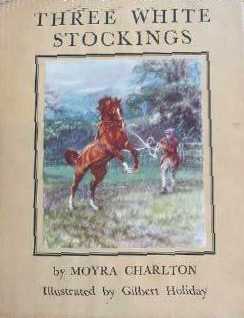
Book Review by 'Tintin' - Three White Stockings by Moyra Charlton
I do like a good horse biography, and this is distinctly above average
In
the days of National Service it was considerably easier to get in the
Army than out of it. One of the few methods was to be discharged as
"temprementally unsuited to military service", the horse equivalent was
terser "cast for vice" although it amounted to the same thing.
The hero and narrator of the book, Chum, a chesnut gelding with the three white stockings of the title was one such horse.
The book follows him from birth to late middle age as he recounts his life to a young colt while out at grass.
Chum
has a tendency to be a little bit full of himself which the author
gently brings out. He is literally headstrong and spends the best part
of the Great War in the Remount Depot and is eventually cast due to his
constantly evading the bit and unwillingness to stand in the ranks. The
staff are firm, but never cruel with him, but eventually lose patience
and let him go.
Prior to the war he had been being trained to be
a hunter and he is fortunate to be bought by a lady (clearly the author
- as the introduction alludes to) who hunts and point to points him.
All
the action takes place in Southern Ireland and any Irish reader, or
reader familiar with Ireland, who is at all horsey will have the
floodgates of recall opened by the many places described or mentioned.
There are some oblique references to the troubles (the distant sound of
gunfire, a burnt out house, being stoned by youths)but the overall
impression is one of gentleness and hospitality
There is a good
cross section of horse life here showing both the similarities and
differences with the modern day. Horse ailments and injuries,
transporting horses and the problems of having to hack out and back to
hunt and race meets in a day when motor horse boxes were very rare -
although there is a useful description of riding in horse boxes from the
horse point of view which is the only one I have ever seen. There is an
interlude with the life of ladybird the Welsh Pony, whose life is even
more interesting than that of Chum.
Comments on the book - a map
of Ireland would have been nice to accompany the beautiful and spirited
illustrations! Unlike most later pony books it is written for those with
a pretty good knowledge of horses. Very good attempt to get into the
mind of a horse and explore the differences to the mind of the
rider/handler. Charming on the simple pleasures of a horse's life.
Rating
- easily a 4 horseshoe book, well written, realistic, very descriptive and
informative, likeable characters you care about. Interesting
aside/health warning on the impact of personal taste on reviews - I
think if I had been half as fond of point to point as the author I would
have given it 5!
PONYMAD RATING: 4 HORSESHOES (VERY GOOD)
You can read more comments and vote on the book:
here
More on Moyra Charlton and her books
here
Book Review by 'Tintin' - Bonny the Pony by Ruth Clarke

Having
touched on the subjective aspects of book reviewing on another thread
this represents a very good example of its application
Not only
is our taste in books and our preference for different aspects of horse
life, or character of people or locale involved, but also our age,
tastes and state of mind at the time we were first acquainted with the
book and even who gave us it.
I was enthusiastically recommended
this book by a very glamorous hunting lady who was quite emphatic, that
after Black Beauty, this was the greatest horse story ever written
I feel an absolute churl at disagreeing, but that is not to say the book is a bad book.
Let
us first look at what is wrong with it. It is all over the place,
things chop and change and are swiftly picked up and put down again. An
awful lot happens, it is very much like a cliff hanger serial as Bonny
gets into all sort of scrapes. Also the writing style chops and changes
and can be a bit odd. The setting and characters are very English yet
constantly say "Sure" and "Gee" in a very American way. Was the author
American living in the UK, or someone who naturally used American
phrases? Also sometimes the author seems not quite sure of the correct
word - I have never heard "harness" used as a term except for draught
horses.
What is good with it? A great deal - it is a good hearted
book full of genuine sentiment. The characters of Bonny (a gelding) and
Frank his owner are delightful and they truly are best friends, they
are both very bold and keep the reader on the edge of their seat with
their scrapes. It is exciting yet does not stray into the realms of the
fantastical. It is unusual in being a book from the austerity period of
the late forties 1946(there are still land girls, far more books are
from the 30's and 50's. It is a beautifully presented book with
delightful illustrations and a handily sized type face. From the site it
appears to be the author's only book, which is a great pity
I
can well understand why my grand foxy friend loves the book so much, she
likes the bond between horse and rider and the adorable character of
Bonny (your love for him made more intense by the shameless, soap opera
style, device of constantly placing him in danger) Also any horse mad
child given this book at the right time, by the right person could n't
fail to love it.
However, I can only give it 3 horseshoes because it very
much needs the tautening hand of an editor (I am sure the sisters could
have made 4 or 5 books out of this)Such loveable characters and location
need a more patient and descriptive hand to flesh them out how they,
and the reader, deserve. A good hearted, attractive book well on the
good side of average. Like several books I have read recently would
perhaps make a better TV series than a book
PONYMAD RATING: 3 HORSESHOES (GOOD)
|
Read more comment and vote on the book:
here
Find out more about Ruth Clarke's pony books
here
Book Review by 'Tintin' - A Ceremonial Death by Thomas Jenkins

Definitely a book for adults (warning SPOILERS)
Told in the first person by a private detective, who is definitely a gentleman.
Set
in the modern day fictional "Prince Alberts Troop, Royal Horse
Artillery" a mounted battery very similar to the real life Kings Troop
RHA
The Troop take over public duties at Horseguards, Whitehall
while the Household Cavalry are at their annual camp. Unfortunately
someone cuts the head off the NCO of the guard just before the 4pm daily
inspection.
This is extremely disruptive to the well ordered, even idyllic, life of the unit.
The
civil police are called in to investigate, but the case is complex
(theoretically almost all the guard could have done it)and the CID
Inspector is obnoxious (typical of a certain sort of Met officer who
knows everything and despises all other cap badges) The victim is also
obnoxious. The men close ranks and clam up.
Fortunately, one of
the officers is in the same club as the narrator and invites him to stay
at the Mess. The detective also invites his nephew to join the party of
Cadets on work experience at the barracks.
The life of the
mounted battery is much more interesting than the rather squalid murder,
but the two are interestingly interwoven. The Riding School scenes are
brilliant. The author rides and hunts and spent some time fact finding
with the Kings Troop and it shows.
The gunners are likeable and
realistic, sadly the horses don't get characters. Because of the subject
matter there is rather a lot of the seamier side of army life, but the
good far outweighs it. Although there is no sexual content, there is
some rather heavy sexual banter, which although typical, some people may
find upsetting. There is not a lot of it though.
I found the book quite uplifting. 5 horseshoes, but very near Gold Cup for me.
Happily there are more stories of Prince Alberts Troop, but regrettably only this one in physical format.
PONYMAD RATING: 5 HORSESHOES (EXCELLENT)
Read more comments and vote on the book:
here